
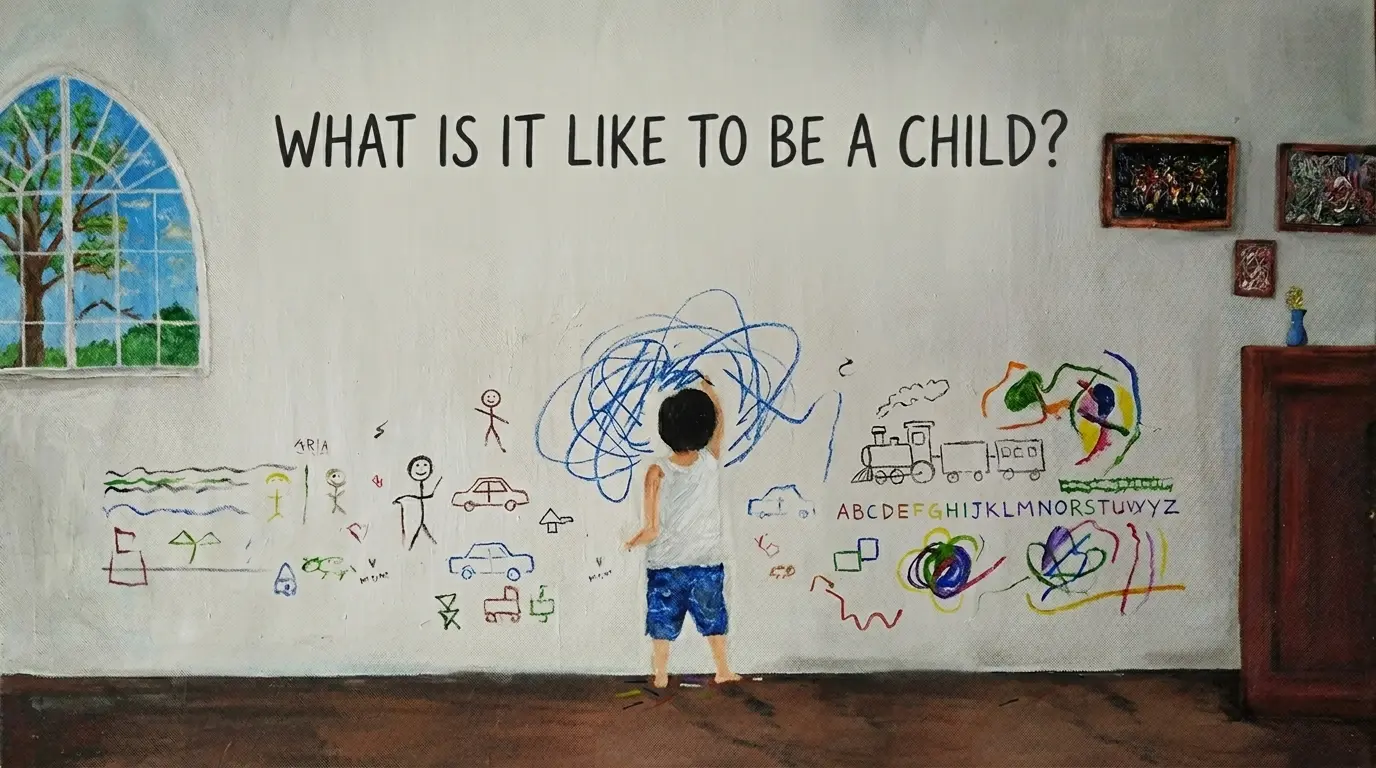
Let me ask a simple question: When we were children, do we remember what it was like to be a child? I don’t; maybe it’s only me. I don’t remember any of my conscious decisions at the age of 4. I remember nothing I mean nothing as if I was never a toddler! Was I really conscious that time or there was something else? I don’t wanna bring much complexity here, but there are still some things worth mentioning. Before understanding what it is like to be a child, first we have to know: do children have consciousness? Obviously, they have consciousness because they respond to their environment, they can recognise their mother, they cry when they feel hungry, and so forth. We can’t say that they don’t have consciousness because without consciousness you can’t recognise or respond according to the environments that way. In addition, we certainly know that they are not a mechanical robot or just intelligence without consciousness. I always become fascinated talking with kids. They are so amusing, and their questions and answers are not constrained by their environments yet. When I talk with children, I always try to understand what is going on in their head. This title is inspired by a famous paper written by Thomas Nagel called “What is it like to be a bat?”[1]. According to him
An organism has conscious mental states if and only if there is something it is like to be that organism.
Now what is it like to be a bat or a child? I know it’s an absurd question, but when we think carefully, we know that bats also respond to their environment; they hunt food, and they live together with other bats. What kind of difference is there between human consciousness and a bat’s consciousness? Consciousness is ‘if there is something to be like that organism’. I don’t wanna go into much depth, but many philosophers of mind think there are two distinct things: one is consciousness and another one is ‘self’. We know all of us were children at one point, but who was responding to those environments if it was not my ‘self’ or I don’t remember any of my act at that time? I have a funny story to share, which is my elder sisters tell me when I was a kid I used to hit them. I reply to them, ‘No way!’ I never did that, but unfortunately it’s true that when I was a kid I used to hit my elder sisters. If my ‘self’ was not there but I was conscious to hit my sisters as a kid, when was I ‘I’? I don’t know the answer. How can I? I was not there; I mean, my ‘self’ was not there, and neither is anyone’s.
An argument can be made against this: if we don’t remember something, it doesn’t mean that there was no me or no ‘self’ at that point of time. Surely, we make thousands of decisions each day, and we barely remember a few of them. But, for example, when I was 16 and I had disputes with my sisters, even if I don’t remember all of those incidents exactly, certainly I can say there was a ‘self’. I was consciously choosing things for myself. Is memory related to ‘self’? Is the main difference between my childhood ‘self’ and my 16-year-old ‘self’ just about the memory? I can remember some of the disputes of mine with my sisters at the age of 16, but when I was a kid, it’s totally blank, just purely blank. While talking about actions and decisions, the question of free will must come there. This is not the main focus of this writing, so I am gonna skip this. It’s very, very difficult to discuss something so sophisticated within a few pages of an essay or a blog post.
A very common thing I observed among many parents in Bangladesh is something I can’t help but to write. I have seen that many parents in Bangladesh scold or even hit children in order to teach them ‘good’ or stop them doing what they are not supposed to do! When I see someone who thinks children have control over them or they have a ‘self’, I feel awful at that time, thinking how dumb those parents are. Don’t get me wrong. What I am saying is that we can and should teach them this is ‘good’ and this is ‘bad’, or we can say you should act kindly and don’t harm others, but still they are not gonna understand or comply all the time. They gonna eventually make mistakes. When I was a kid, if someone wanted to punish me for hitting my elder sisters when ‘I’ or my ‘self’ had no idea why I was doing or acting that way, that would be horrible. Most of the children are adamant; they do capricious things. The next time before shouting at children, we should ask ourselves, 'Is there a “self”? If not, then how can we blame them? We should try to teach (or, if I say it more strongly, manipulate) that conscious being as politely as possible. Many Bangladeshi parents don’t understand that children also have dignity. Scolding them impacts more negatively than doing benefits. Lastly, I feel bad for all the children who had a bad childhood. Also feel bad for those parents who are dumb (sorry to say, but it’s true) to think that by scolding or hitting children they can make them a better person!
Nagel, Thomas. What is it like to be a bat?. Oxford University Press, 2024. ↩︎